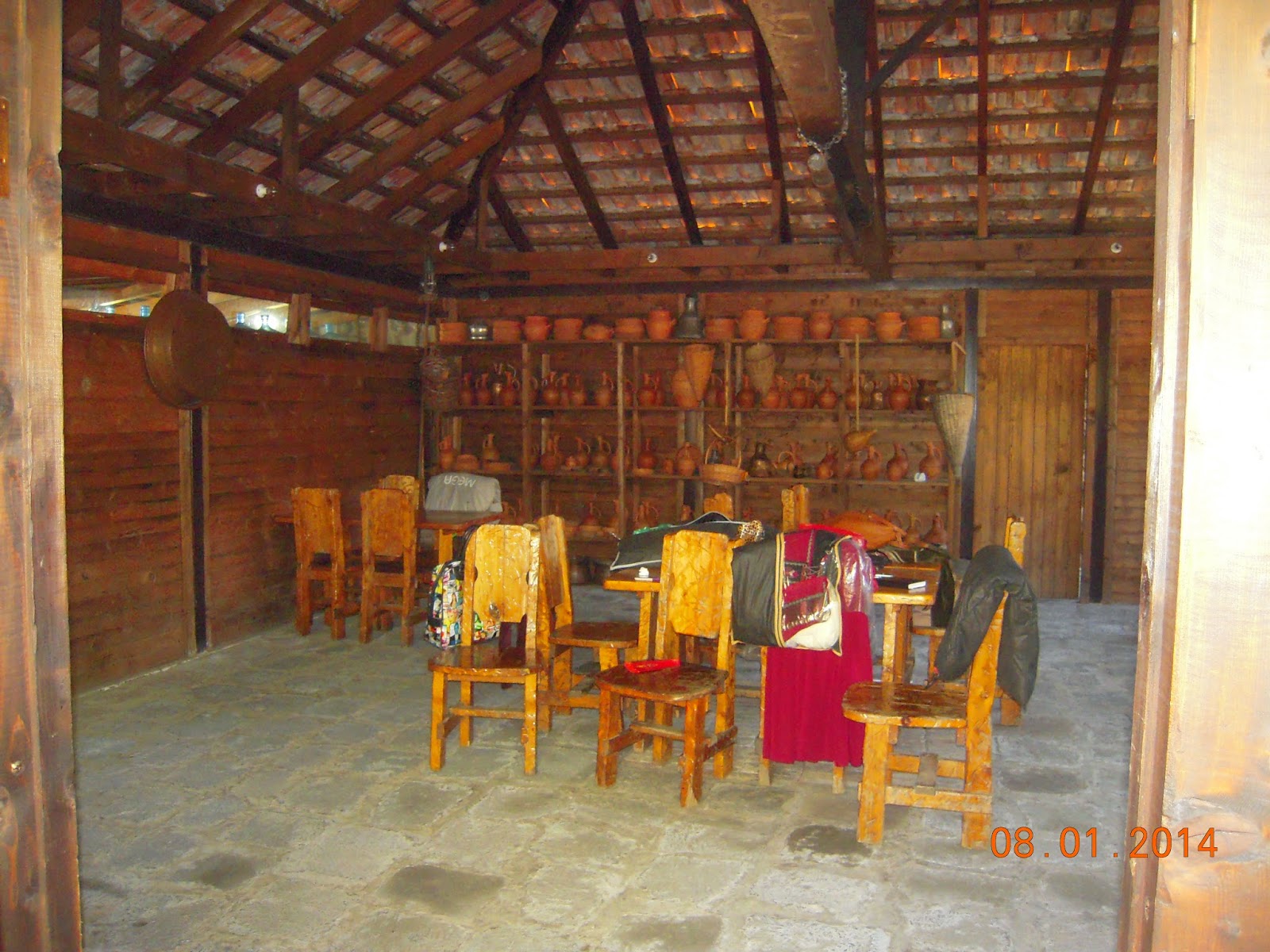
The Grand Hotel Ushba sits at the base of Ushba Peak. This is a photo of the main building where we had dinner from the deck of our building.
This is our building. We had breakfast al fresco on the balcony.
We usually didn't start our day with the toasts required at all the meals we had in the Caucasus Mountains. But I had to suggest one that morning.
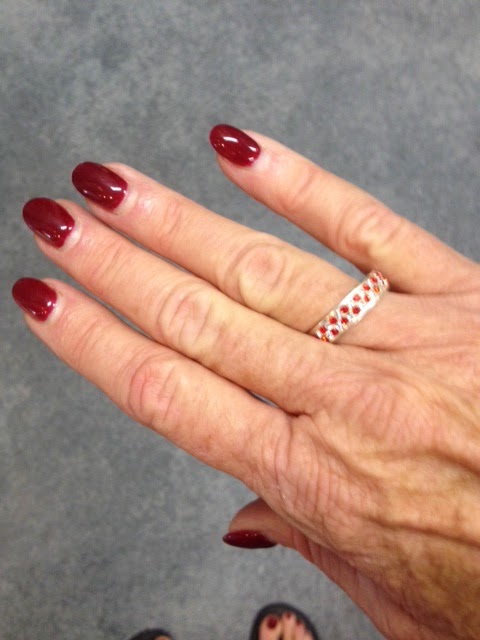
I FOUND MY RING!
It had fallen into the box that I carry my nasal spray in. When the bottle wouldn't come out, I shook it over the bed and in addition to the bottle the ring fell out. I can't tell you how happy I was!
From breakfast we took a walk up the stream cascading down from Ushba Peak. It was a beautiful walk. Along the way were many wildflowers, a church, and a border patrol guy.
The water looked like milk. This is not just the reflection of the sun. The rocks are all white as well and the color of the water comes from the substance the rock is made of.
I can't seem to find the photo of the boarder patrol. He was on horseback with his rifle tucked in the saddle like a cowboy from the old west. His dog trailed faithfully behind him. I must admit that the photo was taken after he had passed us and wasn't looking our way. So, I'm not sure how good it would have been anyway.
After our hike, we took a break to clean up and then headed to our lunch site. This is a little bed and breakfast that caters to the hikers in the summer and skiers in the winter. We did not stay at this inn because it did not have any private baths. However, John Wurdeman wanted us to eat there because the food is so amazing. He wasn't wrong.
The table was set for us. Here's an incomplete list of the cold dishes waiting for us. Two kinds of bread, tomatoes and cucumbers, homemade filtered yogurt, wild garlic salad (they forage for these), thistle salad (also foraged for), roasted salmon trout, trout soaked in lemon juice, cold roasted chicken, chicken legs in walnut sauce, two kinds of homemade cheese, one with mint. Keep in mind that there were only seven of us.
The china our hostess use was the kind you would see at your grandmothers, delicate with flowers.
Then came the hot dishes. Veal ribs, garlic pies, two kinds of meat pies, cheese pies and finally a whole roasted pig that was selected after a trip to three cities including Zogdidi 2 1/2 hours away.
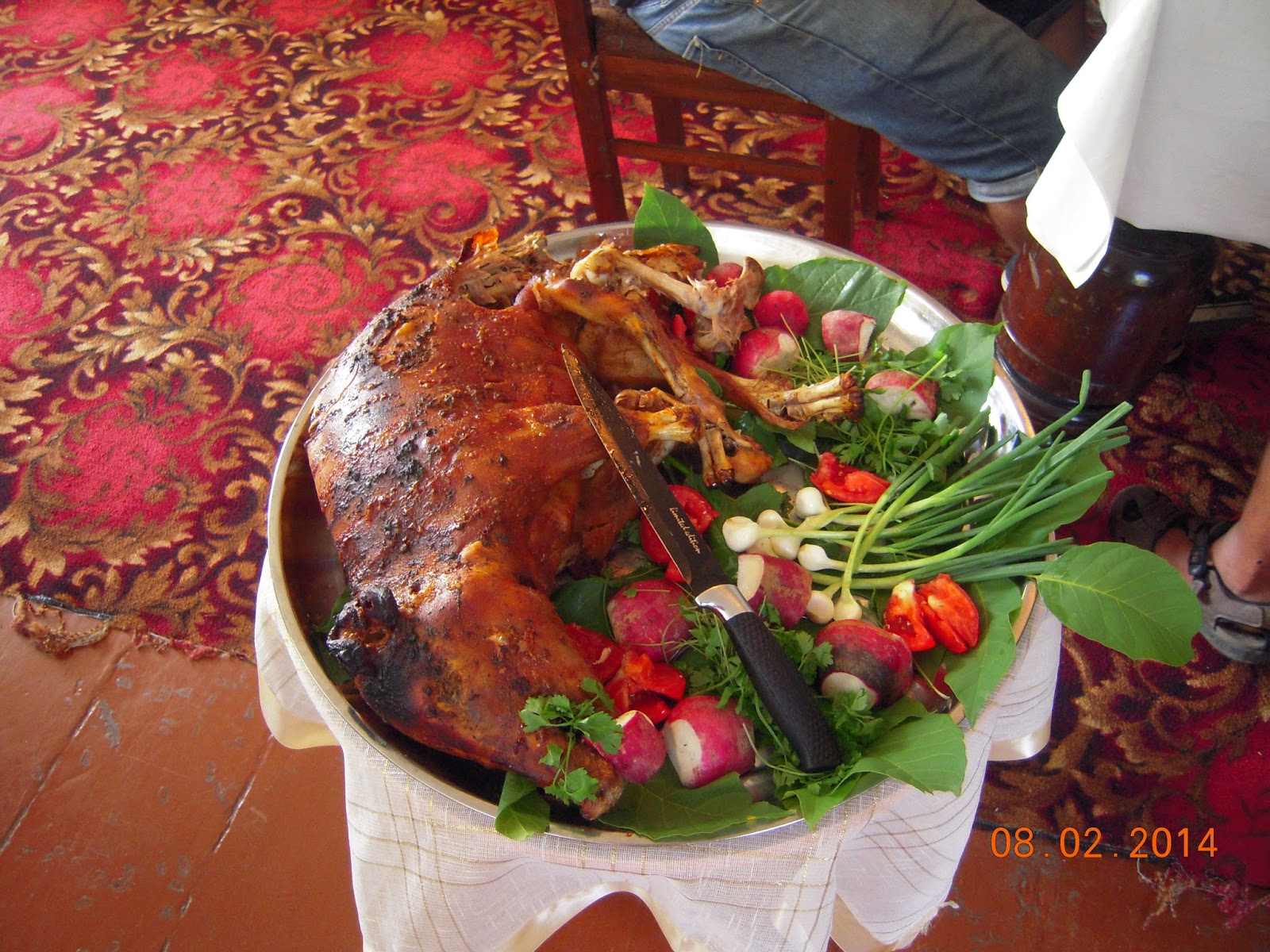
When there wasn't any room on the table for another dish, they simply piled the new offerings on top of the old until our table looked like this.
Then came dessert. Sweet bread, yogurt with homemade plum or wild blueberry jelly, honey from their own hive and Peach ChaCha. Just amazing.
We were all concerned with the overabundance of food prepared. We knew this was a huge expense for this household and they refused to take payment because of their respect for John and all he had done for their area.
John was finally able to convince them to accept enough to cover the cost of the meal. He also learned that the remainder of the food would be used later in the day to feed their guests and to feed many of their neighbors. Anything left on our plates went to their animals and the left overs on the serving plates would be reused. It made all of us feel better.
I wish I had taken a photo of the woman who prepared our meal. Even though we did not speak the same language, she and I had a moment when we were leaving where I tried to express how honored I felt that she had gone to all this trouble to cook authentic Georgian food for us. We both had tears in our eyes.
We left this lovely little inn for a trip to Mestia to visit the museum. Mestia is a town of about 1,000. It has 66 churches with frescoes maintained by the townspeople. Many of the chapels still have regular services with priests. The religion is Georgian Orthodox Christian. One church is 1,000 years old.
Along the way I got a photo of cows in the street. Yay!
These were good cows that hugged the side of the road. However, we regularly had to slow down to let small herds clear out of the way.
Mestia
The towers were built in the 8th or 9th century. They were attached to each house in the community by a tunnel and used for defense. The animals were herded into the bottom floor. The family took the second floor. And the top floor was used for defense. There are small holes from which arrows could be shot. The towers also served as an emergency exit when the snow would cover the houses below.
Next we visited the museum in Mestia that documents the history of the area which is rich and interesting.
After the museum we had a couple of hours to kill before the next meal and decided to rest along the river. John brought his paint and he painted the scene while I sketched it. His is much better than mine and he agreed to sell the painting to us. We should get in in November when he comes to America for a show of his work.
This is the view we were trying to capture.
John's painting that will soon be hanging in our home.
Back in Mestia, we headed for our dinner location. It was in the center of town with a fenced in compound that we pulled the car into. I should mention here that we were in the only Ford Expedition in Georgia complete with a US and Georgian flag in the windshield. The vehicle alone made us stand out.
I didn't take photos at this location because we were in someone's home and because I was unsure of the appropriateness. But, the table was laden with food when we entered and we learned about the importance of the toasts that began and continued throughout all the remainder of our meals in the mountains. The food kept coming until this table too was piled high with delicious traditional Georgian dishes.
Donna and I were the only women allowed to sit at the table with the men. We were instructed by John to participate in the toasts (it would be rude not to). However, we were not to stand as the men stood at each toast.
There is a formal order to the toasts. First a toast to God, next to family, next to honored guests, next to the food we would eat, and then I lost track. But suffice it to say that by the time we had toasted everyone and everything with local wine, local ChaCha and John's wines and ChaCha, my lips were numb. Luckily I learned early in the evening that a sip was the most I could handle. So only my lips were numb not my entire body.
Our entertainment was a male polyphonic choir. Polyphonic music is sung a capella. The leader starts with a tone instead of using a pitch pipe. The songs were sung in Swan. Swan is a dying language with only about 100 people in the world who still speak it. These are the songs that John recorded and his wife is teaching at the music school she runs in their hometown. They also used some traditional instruments to accompany them on occasion and John and his wife are teaching these old traditions to their students as well.
We tried to get a video of the singing but it didn't turn out. Let's just say that if you ever have an opportunity to hear a polyphonic choir, don't pass it up.
It's now midnight and we have another big day tomorrow so we leave after John negotiated a "five more toasts" rule. We exited through the kitchen to thank the women who had worked to hard on our meal and had another touching moment with these women.
Tuesday, October 14, 2014
Monday, October 13, 2014
Batumi, Zogdidi and Svaneti
Off to the airport we went again. This time to visit the seaside resort of Batumi.
We met our guide, John Wurdeman, and his helper, Nathan. John is a Renaissance man. He is an American citizen who has expatriated to Georgia. He married a Georgian woman and has two children.
At 16 John traveled to Russia to request a seat in the prestigious Surikov Institute of Art in Moscow. With little formal training, it was a very unusual situation. But, he arrived on the day the panel was interviewing. After the interview, he was the first and only American student.
John became interested in the traditional polyphonic music sung in the mountains of Georgia and went there in search of the choirs. He found them, and in addition to painting the beautiful scenes of the Caucasus mountains, he tapes the songs to save for posterity. He has also taken one of the groups he found on tour in the United States.
In addition to painting and taping polyphonic music, John is also a vintner. His label is Pheasant Tears. He ages his wine in clay pots underground instead of barrels and uses a natural process that eliminates the tannins that cause headaches. So, I was able to drink the wine there. Yay!
At the airport we met the Mother Superior or Abbottess of the local Orthodox Christian convent. She was escorting her mother to the airplane we were on and John introduced us.
In Batumi we stopped for breakfast at a beautiful restaurant. The food was delicious and the setting wonderful.
These women were polyphonic singers practicing for a performance. You can see their costumes on the chairs in the photo above them.
Next we drove to the Batumi Botanical Garden. It includes separate sections with plants native to the area they have designated: New Zealand, a rose garden, bamboo plantation, Mediterranean, Mexican, North American and a forest preserve. Lots of area to travel so we took the tour bus.
From there we drove to Zogdidi a city slightly north and inland of Batumi. More food. I don't have any photos of Zogdidi. But we started lunch with ChaCha. ChaCha is a local drink made in all the communities throughout Georgia. They also make their own wine. Almost every family has their own grape vine and makes their own wine as well.
The remainder of the day was spent driving to Svaneti. It was a beautiful trip up into the mountains along a river bed on winding roads littered with wandering cows.
Finally we turned down a rutted dirt road and past small homes with cows in the road (never did get a good photo of all those cows). As darkness fell we arrived at our hotel for the night the Grand Hotel Ushba at the base of Ushba Peak.
Dinner was ready for us and we were entertained by a group of traditional dancers who were using the restaurant as a practice facility.
Dinner was a feast, or so we thought at the time, with several dishes in each course.
The walk down the hill to our rooms was treacherous but we were all happy to be in the "plush" rooms that had private bathrooms. The other rooms were bunk rooms with shared bath facilities. By bath facilities, I mean an indoor outhouse. The shower came complete with a mop to keep the water from leaking into the bedroom area. Not quite up to the standards of La Maison Arabe in Marrakesh.
We met our guide, John Wurdeman, and his helper, Nathan. John is a Renaissance man. He is an American citizen who has expatriated to Georgia. He married a Georgian woman and has two children.
At 16 John traveled to Russia to request a seat in the prestigious Surikov Institute of Art in Moscow. With little formal training, it was a very unusual situation. But, he arrived on the day the panel was interviewing. After the interview, he was the first and only American student.
John became interested in the traditional polyphonic music sung in the mountains of Georgia and went there in search of the choirs. He found them, and in addition to painting the beautiful scenes of the Caucasus mountains, he tapes the songs to save for posterity. He has also taken one of the groups he found on tour in the United States.
In addition to painting and taping polyphonic music, John is also a vintner. His label is Pheasant Tears. He ages his wine in clay pots underground instead of barrels and uses a natural process that eliminates the tannins that cause headaches. So, I was able to drink the wine there. Yay!
At the airport we met the Mother Superior or Abbottess of the local Orthodox Christian convent. She was escorting her mother to the airplane we were on and John introduced us.
In Batumi we stopped for breakfast at a beautiful restaurant. The food was delicious and the setting wonderful.
These women were polyphonic singers practicing for a performance. You can see their costumes on the chairs in the photo above them.
Next we drove to the Batumi Botanical Garden. It includes separate sections with plants native to the area they have designated: New Zealand, a rose garden, bamboo plantation, Mediterranean, Mexican, North American and a forest preserve. Lots of area to travel so we took the tour bus.
From there we drove to Zogdidi a city slightly north and inland of Batumi. More food. I don't have any photos of Zogdidi. But we started lunch with ChaCha. ChaCha is a local drink made in all the communities throughout Georgia. They also make their own wine. Almost every family has their own grape vine and makes their own wine as well.
The remainder of the day was spent driving to Svaneti. It was a beautiful trip up into the mountains along a river bed on winding roads littered with wandering cows.
Finally we turned down a rutted dirt road and past small homes with cows in the road (never did get a good photo of all those cows). As darkness fell we arrived at our hotel for the night the Grand Hotel Ushba at the base of Ushba Peak.
Dinner was ready for us and we were entertained by a group of traditional dancers who were using the restaurant as a practice facility.
Dinner was a feast, or so we thought at the time, with several dishes in each course.
The walk down the hill to our rooms was treacherous but we were all happy to be in the "plush" rooms that had private bathrooms. The other rooms were bunk rooms with shared bath facilities. By bath facilities, I mean an indoor outhouse. The shower came complete with a mop to keep the water from leaking into the bedroom area. Not quite up to the standards of La Maison Arabe in Marrakesh.
Friday, October 10, 2014
Beautiful Tbilisi
We didn't have much time in Tbilisi but Frank gave us an overview of this beautiful, historic city. After a short ride through town to get oriented, we stopped at the Pur Pur Restaurant for lunch.
Through this door and up these stairs we found a most charming bistro.
The bathroom light fixture was covered with a dress as the shade and the bathroom sink was painted with pink roses. Not sure you would ever see anything like this in the US.
Our next stop was the funicular atop one of the mountains surrounding the city. On the way, Frank showed us an amazing, incomprehensible natural phenomenon. If you put the car into neutral at a certain spot on the drive up the hill, the car goes backward up hill all on its own. None of us could figure out why it happens but it was amazing.
This is Tbilisi from the top of the mountain. Note the modern structures in counterpoint to the historic buildings. The boring white complex at the top of the first photo was Russian built. Probably not a surprise that it was built by the Russians.
The bottom photo is of a private residence. It is partially built over a roadway. Obviously the builder had an in with the zoning commission.
Here we are waiting for our funicular ride.
This church was one of the oldest in the city hanging onto the side of the mountain.
From the funicular, we went to the Gold Market. We bought Margot a necklace of Russian gold and I bought a $7 replacement for my 40th anniversary ring. It didn't compare but was sort of close to what the original ring looked like.
It had been a long day and Frank sat down to take a break. His break turned into a snooze.
Then I thought I should take a photo of the market so I could show Margot what it looked like. Here's my first photo.
When I noticed what was in the foreground of the photo, I took another. But, it doesn't have quite the same charm as this one. Frank quipped, "Just say no to crack."
We had a lovely dinner that night but I can't seem to find the name in all my notes. We called it an early night because the next day we would be off on another adventure.
Through this door and up these stairs we found a most charming bistro.
The bathroom light fixture was covered with a dress as the shade and the bathroom sink was painted with pink roses. Not sure you would ever see anything like this in the US.
Our next stop was the funicular atop one of the mountains surrounding the city. On the way, Frank showed us an amazing, incomprehensible natural phenomenon. If you put the car into neutral at a certain spot on the drive up the hill, the car goes backward up hill all on its own. None of us could figure out why it happens but it was amazing.
This is Tbilisi from the top of the mountain. Note the modern structures in counterpoint to the historic buildings. The boring white complex at the top of the first photo was Russian built. Probably not a surprise that it was built by the Russians.
The bottom photo is of a private residence. It is partially built over a roadway. Obviously the builder had an in with the zoning commission.
Here we are waiting for our funicular ride.
This church was one of the oldest in the city hanging onto the side of the mountain.
From the funicular, we went to the Gold Market. We bought Margot a necklace of Russian gold and I bought a $7 replacement for my 40th anniversary ring. It didn't compare but was sort of close to what the original ring looked like.
It had been a long day and Frank sat down to take a break. His break turned into a snooze.
Then I thought I should take a photo of the market so I could show Margot what it looked like. Here's my first photo.
When I noticed what was in the foreground of the photo, I took another. But, it doesn't have quite the same charm as this one. Frank quipped, "Just say no to crack."
We had a lovely dinner that night but I can't seem to find the name in all my notes. We called it an early night because the next day we would be off on another adventure.
Subscribe to:
Posts (Atom)