Monday, September 29, 2014

Istanbul Tour Day


We began our day with breakfast at the rooftop restaurant in the Hotel Alzer. Out our window was this scene of one of the obelisks in the Hippodrome in the foreground and the Sultan Ahmed Mosque (the Blue Mosque) in the background.

The Iman was calling the faithful to prayer and gulls dotted the sky. It was the most exotic and foreign place I'd ever been. (Until later in our trip.)

THE HIPPODROME


We met our guide outside the hotel for a walk through the Hippodrome. Built about 200 AD, it served as the chariot race track in Byzantine times.

This obelisk was carved in Egypt about 1500 BC and was moved to this site about 400 AD. Our guide tells the story that it was three times taller that what we see here. Two of the three pieces being lost at sea in transit.

Today the area is a gathering place with benches, green spaces and smooth cobblestones.

On a bench later that afternoon, I saw the diversity of their Islamic culture in action. On the far left of the bench was a woman completely covered. She wore a black burqua complete with mesh over her eyes and gloves on her hands. Next came a woman in a burqua but her nose and eyes were exposed. Third was a woman in a hijib (head scarf) wearing an overcoat that became popular in the 1980's with college women wanting to recognize their religious roots. Fourth, a woman in jeans and a t-shirt and a hijib. And finally, a young woman in cut off jeans and a crop top (no headscarf goes without saying). They were chatting away merrily as they supervised children snatching bites from the picnic basket at their feet.

I did not even attempt to take a photo of this. It did not seem appropriate at the time and I didn't want to offend anyone in this place that seemed so foreign to me.

 THE BLUE MOSQUE

Built about 1600 AD by Sultan Ahmet, the formal name is the Sultan Ahmet Mosque. However, it is know as the Blue Mosque because of the blue tiles on the walls of the interior. I thought it looked blue in the morning haze from our hotel.

This is the interior courtyard where visitors are allowed to enter the mosque. Women are required to cover their heads. If they don't have a scarf, one is provided. Everyone must shed their shoes and are given a little bag to carry them in.

Inside visitors are kept from the prayer area. But the blue tiles can be seen in the background of this photo. The lights suspended from the ceiling are electric now. However, in 1600 when the mosque was built, they used candles or oil lamps. The architects of that time designed a ventilation system that sucked the soot from the room to keep it clean.

The intricate tile work in the ceilings speaks to the skill of the craftsmen who built this structure.


Sunday, September 28, 2014

Istanbul


Our hotel in Istanbul was the Hotel Alzer. Located across the Hippodrome from the Blue Mosque in "old" Istanbul, it was the perfect location. We were able to walk from the hotel to all the interesting sites we would see during our time there.

The hotel is operated by Memet Gulseven, a long-time friend of the Greinke family. Memet has excellent English and contacts in the area for everything from purchases at the Grand Bazaar to leather goods made while you visit.

Here's Memet and his staff wrapping up some of our loot from the Bazaar for safe transit.


Ramadan was in full swing while we were in Istanbul. The Hippodrome, which was right in front of the hotel, was a gathering place for many people as they waited for the call to prayer at sunset and the breaking of their daily fast. I was interested to learn that Muslims not only do not eat during the day but they also do not drink any liquid during that time. Given the heat, probably 90 degrees or more, I was surprised that they take no liquid from sun up to sun set. Another interesting thing is that children under the age of 12 are exempt from fasting.

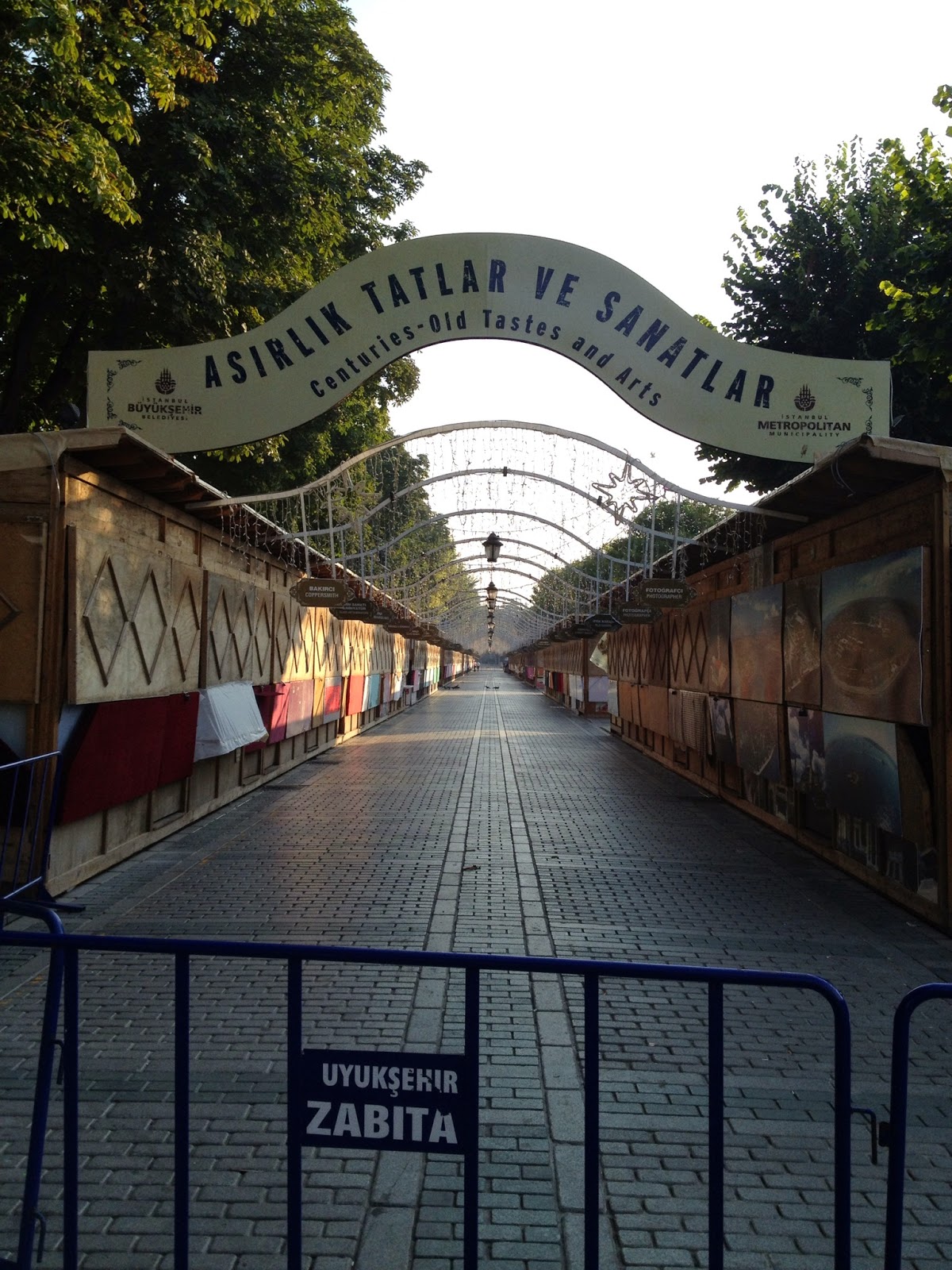
As they waited for the call, they spread out blankets with the food they would eat and sat patiently waiting for the Iman's voice to come over the loud speakers. After the call from the Blue Mosque, you could hear the same call repeated at mosques all over the city. Then almost everyone stayed in the Hippodrome until the early hours of the morning talking and shopping at the booths set up for Ramadan.


Muslims in Turkey who do not practice the restrictions of Ramadan call themselves "republicans."

The next day the four of us jumped on the local trolley and took the Marmara Line to the ferry. The ferry took us to Uskadar (Asia). We only did this to be able to say we had been in Asia as well as Europe, Africa and, of course, North America where we started. That gave us four continents in two weeks.

Lunch was back on the European side of the Bosphoros at a restaurant under the Galata Bridge. From there we toured the Egyptian Spice Bazaar and took a quick walk through the Grand Bazaar.

The Grand Bazaar has 6,000 booths featuring all kinds of goods for sale. The architecture was amazing. I particularly liked the ceilings. They were made many centuries ago.


That afternoon, Jon and I had our first Turkish Bath. As one would expect in a Muslim country, men and women bathed separately.

I thought I wanted to do this before we came and my advise to anyone who finds themselves in Turkey is to be sure to take advantage of this unique custom.

The building the baths were in was built in about 1000 common era. I always thought of Turkish baths being filled with steam. But, the architects who designed these buildings built in a complicated series of vents at the top of the dome-shaped rooms to draw the steam from the room.

It was still very hot and humid. The bathing process itself was quite interesting. First, a woman, who spoke just enough English to get her point across, brought me into the domed room. It had stained glass windows and a large marble platform in the middle. Arranged around the sides were smaller cubicles where as many as eight women could sit on the marble benches. Three water basins without drains were on the sides with both hot and cold tap water.

Once I was seated on the bench, with out clothes, she poured water over my head and body with one of the brass bowls resting on the basin. Then she scrubbed my body from head to toe with a loofa and covered me in a gray paste. The most difficult thing about the Turkish bath is to sit on the marble without sliding to the floor from the gray paste.

She brought me a glass of water and a huge plate of fresh fruit to munch on while I waited the 10 to 15 minutes for the paste to do its work. That was the second most difficult thing to do: eat a piece of fruit without getting gray goo on it.

After rinsing off all the paste, she washed and conditioned my hair. Then I was escorted to the marble platform. It was large enough for 20 or more women to lie head to toe around the circumference.

 I laid down on a towel and she poured more water over my body. Then taking what looked like a pillow case, she wet it, rubbed soap in it and squeezed the water over me. She took the pillow case and fanned it open until it billowed with air. Holding the open end closed, she stripped the bubbles from the fabric over and over again until I was covered from head to toe in bubbles. The popping bubbles tickled.

Once I was completely covered in bubbles, she washed my entire body under them. I could feel her hands on my skin but I could not see them through the soap. I'm sure this was a way to protect both my and my washer from embarrassment in this modest society.

I turn over and she repeats the process on my back. Then rinses me and takes me over to yet another basin for another rinse.

From there we go to the massage room where she gives me a 30 minute light massage. I have to say I walked out of there grateful for the short walk to the hotel. I felt relaxed and pampered.

This is a must do in Turkey!

Dinner that night was at a restaurant called Surplus on the shore by the Galata Bridge. On the way back we noticed that the mosques had signs in lights strung between the minarets. Most likely they said, "Let us love, let us be loved."


We returned to the hotel to sit on the patio outside the hotel with Memet and watch the people enjoying the Hippodrome during Ramadan.


Monday, September 22, 2014

Why this trip?

Jon and Frank met about 20 years ago at the Orange Coast chapter of Young Presidents Organization. They became great friends on the YPO trip to Cuba when they discovered their mutual love of Hemingway.

Frank is the owner of a family built and run company in Orange County called SC Fuels. It is about time for him to retire and turn the reins over to his son. So, he decided to take a year sabbatical to spend time in the Republic of Georgia where his family business helped the country with the construction of gasoline stations and to travel the world. While Frank is away, Jon is serving as the Chairman of the Board of Frank's company.

Frank asked us to join him in Georgia before his year sabbatical ended. He also has visited Istanbul and Marrakesh on many occasions over the 20 years or so that he's been traveling to the area and agreed to be our tour guide in those locations as well.

This is the story of our amazing trip together.

We'll start with Istanbul in my next post.

Wednesday, September 10, 2014

The Excellent Adventures of Frank, Donna, Jon and Susan


Over 13 days in July and August, 2014, Jon and I were fortunate to travel with Frank Greinke and Donna Kuhen to Istanbul, Morocco and the Republic of Georgia. We logged over 19,000 commercial air miles crisscrossing the Mediterranean Sea and a few hundred in a helicopter over the Caucasus Mountains on a most excellent adventure.

We did and saw things I had always hoped to do or see. But we were also exposed to things I would never have imagined.

The next few entries will go into detail about our experiences. Frankly, this is a test to see if you can get into my blog.


So, let me know if you got in OK.

Friday, January 11, 2008

In Memory


Betty Jean 'BJ' Wampler
May 17, 1925 - December 21, 2007
Married William James 'Pete' Wampler - August 17, 2007
Son William Michael - born August 1, 1949
Son Jon Randolph - born July 18, 1951
I remember the first time I met Betty. (Everybody in Marion called her Betty. She didn't become BJ until she and Pete moved to Tucson in 1992.) Boy was I surprised and intimidated.
Since Jon was from the "small" town of Marion (40,000) as compared to Anderson (80,000), I didn't expect to walk into a home that looked like it could have been in Architectural Digest . . . open floor plan, white polished marble tiles in the enrty and halls, lavender carpet in the living room, modern art on the walls . . . absolutely breathtaking. It was such a contrast to my family home that was early American and cluttered.
I was met at the car by Trina the Pit Bull who didn't know me and was not sure I should get out. Jon helped me out of the car and introduced me to the dog. Once Trina figured out I belonged there she protected me just like all the other family members.
Standing in the front door was Betty. All of 5 feet tall she still scared the poop out of me. Her size had nothing to do with her huge personality and command presence. I was to learn that she was the boss in the family, no questions asked.
Over the years Betty and I had our conflicts. But in the end we shared a genuine affection that went beyond being in-laws. I turned out to be the daughter she never had and we had lots in common.
Although Betty was always a gracious hostess it took me years to really become comfortable in her home or in her presence. Her high standards, which she passed on to her son Jon, were always so intimidating.
After Margot was born many things changed. I will never forget how much love Betty and Pete lavished on Margot. While both Betty and Pete loved their sons very much, affection was not often shown in their family. The arrival of Margot, a girl, seemed to give them permission to show their love outwardly. Margot ended up being a great gift to the Wampler family on that basis alone.
I'll miss BJ. I like that name better for her now. She became a very positive person in the last decade of her life. I can't tell you how often I heard her say, "Aren't we lucky?"
Yes we are BJ. We are lucky you were in our lives. See you on the other side.

Thursday, November 15, 2007

Xi'An The Terracotta Warriors

We started our day in Xi'An at the Banpo River Village. This is an archialogical dig of a village that is 6000 years old. It is one of the oldest excavations in the world and shows an amazing amount of sophistocation on the part of these ancient people. The village had a moat dug around it to protect the inhabitants from wild animals at night. There was a trench dug from their latrine away from the water source indicating they had at least some knowledge of health issues from human waste. They had huge kilns in which they fired all kinds of pottery, even the earliest known porceline. My photos from there were very bad so I didn't include any here.
Our next stop was the Terracotta Warriors. Since it was National Day, our guide estimated there were at least 30,000 people there when we were. Many of them were foreigh tourists. But most of them were Chinese tourists on holiday to visit one of thier country's greatest treasures. Many looked at us with interest because they came from even more remote places than Xi'An and had not seen many Westerners.
Several things were particularly striking to me. First the size of the dig. It is at least three football fields under roof in the main pit where 6000 warriors are burried. When the warriors are first excavated they still have the vivid colors painted on them 2200 years ago. Unfortunately the color fades shortly after being exposed to air. So, they are not excavating any more until they can figure out a way to keep the color from fading.


The sheer size of this building was a real surprise to me.

This is how they found many of the warriors when initially excavated. But as you can see they have reconstructed many of them and left them as they would have been first burried.
There are three pits that have been excavated so far. However, they have identified 183 more pits that have something burried in them. They are in the process of acquiring all the land that runs from Pit #1 to the burial mound of the Emperor who did all this, the first Emperor of the Qin Dynasty. They intend to excavate all of the pits in the future but have to gather funds to cover the costs and are hoping to have the issue of the paint fading solved before they start work on new pits. There are going to be some incredible finds in the future. It will be interesting to watch what comes out of the new pits.
Xi'An was an interesting town of 7 million people. Being there on a holiday meant it was extremely busy on the streets and in the shops. They had a huge mall of sorts that ran two full blocks square and at least five stories. The shops inside were more like booths in a Mexican mercado. But you could buy anything within those walls. Everything from appliances and water heaters to baby booties. And, boy was it crowded! Another place where I got the sense of just how many people there are in China.
This is the only place I saw what I had expected to see everywhere. . .mothers pulling down the pants of their toddlers to let them pee on the sidewalk. The child I saw was none too happy about doing it right there on the sidewalk in front of hundreds of people but her mom won. They calmly pulled up the pants and went on their way when the child was done, leaving a puddle right in the middle of the sidewalk. We curb our dogs here but they don't even try to curb their children there. Actually I was glad to see it because I had expected to see it more often.
Xi'An is also where I got very familiar with this type of toilet. This is a clean one. At the Terracotta Warriors Mary and I skipped the privledge of using their facilities because they were sooooooo gross. Also, just in case you need this info in the future, take your own toilet paper. None is provided by the management.

Wednesday, November 7, 2007

Flood and Fires


One of the reasons we haven't left Shanghai in our tour across China and Japan is because of this. Jon and I had been home for five days. . .just enough time to start this blog and begin to dig myself out of three weeks of bill paying, etc. . .when the toilet in the master bath overflowed. There was at least two inches of water through out the entire master suite. It even leaked through the walls to Jon's office. What a mess!

So, when the fires hit Southern California during the Santa Ana winds, we were stuck in an unairconditioned house that had to be closed in 85 degree weather. We'd have had the doors closed anyway because of the smoke and soot. However, adding six big blowers and three dehymidifiers to the mix was quite an ordeal.

Once we mitigate the mold it will be a couple of weeks to put the whole place back together at a cost of over $11,000. Thank goodness for insurance! Of course, the key is when we will get the mold dealt with. I'm just hoping we'll be done before Christmas.


This is what my office looked like for 10 days. Doesn't look much better now but at least the furniture is back in place and the minimal computer damage was repaired yesterday.

So, tomorrow more on China.